Gede Pangrango Motorcycle Touring: Turn Your Ride Into a Climb
gedepangrangomountain.com – There is a moment on the Puncak Pass, somewhere past the tea plantations where the road starts throwing switchbacks at you and the air turns cool enough to feel through your riding jacket, when a lot of touring riders start noticing the mountain. Not as scenery in the background — as a place they could actually stand on top of. If you are already crossing West Java by motorcycle, chasing volcanic backroads and mountain passes, that instinct is worth listening to. Gede Pangrango motorcycle touring is really about exactly that: treating one of Java’s most iconic peaks not as a separate hiking trip you have to plan from scratch, but as a stop you fold straight into the ride you are already taking.
This is written for riders first — people already thinking in terms of ADV bikes, dual-sport routes, and long days in the saddle — who are wondering whether Gede Pangrango can realistically fit into a Java touring itinerary, and what it actually takes to turn a ride into a summit.
Why Gede Pangrango Motorcycle Touring Makes Sense on a Java Route
Mount Gede Pangrango sits almost directly along the Puncak corridor that connects Jakarta, Bogor, and Bandung — which means for a lot of touring routes, it is barely a detour at all. You are riding through this stretch of West Java anyway, past the tea estates and volcanic hill country; the mountain is simply asking you to stop the bike, swap riding boots for trekking boots for a day or two, and walk the rest of the way up.
It also breaks up a touring itinerary in a way pure road riding cannot. Cool cloud forest, moss-covered volcanic rock, the sulfur vents near Kawah Wayang, a crater rim view that most people driving through the Puncak pass never see — none of that is reachable by bike, but all of it is reachable by riders who are willing to park the motorcycle for a day and walk in.
Meet the Trailheads: Cibodas, Gunung Putri, and Selabintana
Gede Pangrango National Park has three official trailheads, and which one fits your route depends on where your touring loop already has you.
Cibodas — The Main Gateway
Cibodas sits right on the Puncak corridor itself, at the edge of the Cibodas Botanical Gardens between Cisarua and Cipanas. For riders already running the classic Jakarta–Puncak–Bandung line, this is the trailhead your route practically passes through on its own. It is also the most developed of the three, with the largest visitor facilities and the widest quota of the park’s three gates.
Gunung Putri — The Steady Climb
A short ride further along, on the Cipanas side, Gunung Putri offers a more direct, consistently uphill line toward the summit. The final stretch in is narrow village road rather than highway, which suits a motorcycle far better than a car — one more reason this trailhead tends to appeal to riders rather than tour buses.
Selabintana — The Quiet Southern Route
For a longer, more scenic detour, Selabintana approaches the mountain from Sukabumi on the southern side, reached via the BOCIMI toll road and then a run of gentle roads past rubber plantations and kampung on the way into the hills. It is the least touristed of the three gates and a genuinely rewarding stretch of riding in its own right, quite apart from the mountain waiting at the end of it.
How JavaRide and GedePangrangoMountain.com Work Together
The part that usually stops riders from actually doing this is logistics: who handles the bike while you are climbing, who arranges the permit and porter, and how the two halves of the trip — riding and climbing — actually connect. That is where working with a dedicated touring operator makes the difference between an idea and an itinerary.
JavaRide runs private motorcycle trips across Java, and for riders who want to fold a Gede Pangrango summit into their route, JavaRide handles the riding side in full — the motorcycle, gear, a support vehicle, a road captain, and a mechanic on call — while working directly with our team here at GedePangrangoMountain.com, a fellow operation under the same Java Private Tour group, to cover everything on the climbing side: the SIMAKSI permit, an experienced mountain guide, and porter support if you want one. Instead of coordinating a road trip and a hiking trip as two separate bookings with two separate operators, riders get one connected plan, with your bike kept secure at the trailhead while you are up on the mountain.
What Kind of Bike Actually Suits This Route
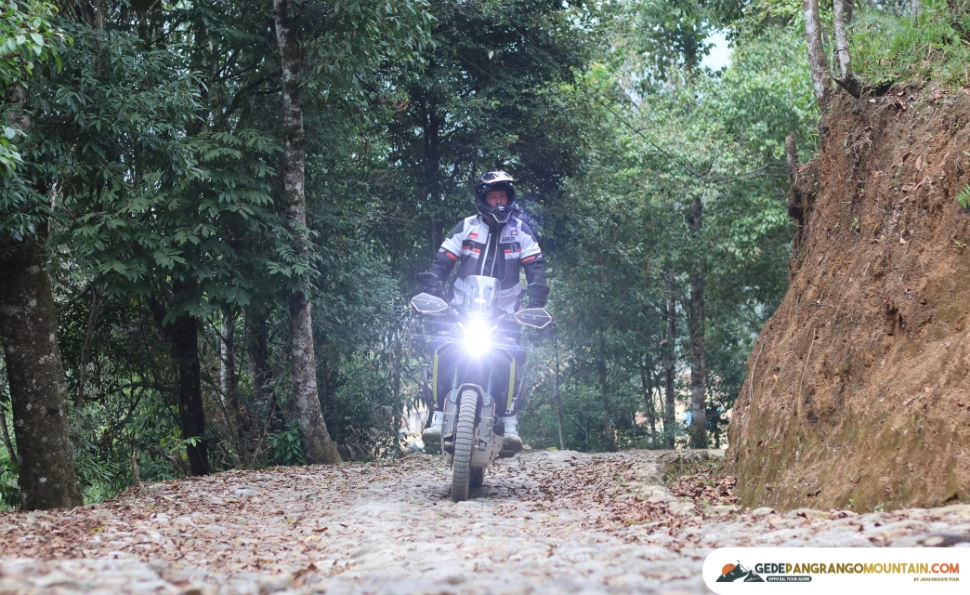
It is worth being clear about what riding to Gede Pangrango’s trailheads actually calls for, because it is not the same as a beach-cruise scooter rental. JavaRide’s fleet runs toward ADV and dual-sport machines, motocross bikes for the rougher, unpaved stretches, and Harley-Davidson models for riders who want to hold the paved Puncak and BOCIMI corridors in proper touring style. The one automatic option in the lineup is the Yamaha X-Max — a capable, comfortable bike for the highway sections, but still a different class of machine from the small matic scooters you would rent off a stand in Bali. The roads leading to Gunung Putri and the outer stretches near Selabintana can turn to broken pavement or loose gravel without much warning, and a proper dual-sport or ADV platform handles that transition without drama, which matters more here than it does on a straightforward point-to-point ride.
Planning the Stop: Permits, Timing, and Where Your Bike Waits
Climbing access to Gede Pangrango runs through the park’s official SIMAKSI booking system regardless of how you arrive, with separate daily quotas for Cibodas, Gunung Putri, and Selabintana, and defined check-in windows at each gate — generally earlier and tighter on weekdays, a little more relaxed on weekends and holidays. Because slots are limited and booked in advance, the climbing dates on a touring itinerary need to be locked in before the rest of the route is finalized, not the other way around.
The park also closes to climbers for an extended stretch most years, commonly falling somewhere in the January to April window, to let the ecosystem and trail conditions recover, with occasional short closures at other points in the year as well. Any Gede Pangrango motorcycle touring stop should be planned against current park status rather than assumed, since exact dates shift year to year.
While you are on the trail, your motorcycle needs somewhere safe to sit for a day or two — this is arranged as part of the combined plan rather than left for you to figure out at the gate, which is one of the more underrated conveniences of booking the ride and the climb together instead of separately.
What a Combined Ride-and-Climb Stop Looks Like
In practice, most riders who add Gede Pangrango to a Java touring route treat it as a two- to three-day pause inside a longer trip rather than a full detour home and back. A typical shape looks something like this: ride in along the Puncak corridor from Jakarta or Bandung, arriving at Cipanas or Cibodas with enough daylight left to settle in, hand the bike over to be kept secure, and get an early night before an early start. The climb itself — depending on the trailhead and whether you are doing a there-and-back day hike to the crater rim or a full overnight summit push with a stay at Kandang Badak or Suryakencana — typically runs one to two days. Once you are back down and the bike is handed back, the touring route simply continues from wherever it left off, whether that is further into the Puncak highlands, south toward the coast, or on toward Bandung.
What makes this workable on a touring schedule rather than a headache is that the two halves of the trip are planned together from the start — permit dates fixed against the SIMAKSI quota, riding days built around them, and one team handling the handoff between the bike and the trail — instead of a rider trying to independently coordinate a national park booking on top of an already complex road itinerary.
A Few Practical Notes for Riders
Riding gear and hiking gear are not the same kit, so plan for the swap: boots, layers, and a daypack for the mountain, packed separately from what you are wearing on the bike. Weather on Gede Pangrango shifts fast, with mist rolling in over the crater rim and temperatures dropping hard after dark, so bring warmer layers than the ride up the Puncak pass might suggest you need. And once you are off the bike and on the trail, the same respect that keeps Java’s roads rideable for the next visitor applies to the forest: stay on marked paths, carry your rubbish back down, and leave the moss, the orchids, and the birdlife exactly as undisturbed as you found them.
Timing matters on both ends of the trip. The dry season months generally give you the best combination of rideable mountain roads and clearer trail conditions, though West Java’s weather can still turn without much notice, so pack for rain on the ride regardless of the forecast. If you have not climbed at altitude before, the thinner air above Kandang Badak can hit harder than the distance on a map suggests — pace yourself on the ascent the same way you would pace a long, technical stretch of road, and the mountain tends to reward the patience.
None of this needs to be worked out solo. Whether you are riding your own Java loop and want to slot Gede Pangrango in partway through, or building a whole trip around the idea of pairing a motorcycle route with a summit, a coordinated plan between the riding side and the climbing side is what turns the idea from a nice thought on the Puncak Pass into an actual itinerary.
So, if you’re ready to explore the wonders of Mount Gede, head over to our ONLINE BOOKING PAGE and let’s start planning your adventure. Or simply CLICK THIS LINK to chat with us on WhatsApp. With our team, you’re not just getting a guide; you’re gaining a local friend who will ensure your trip is nothing short of extraordinary.