
gedepangrangomountain – Long before Mount Gede–Pangrango National Park became a beloved destination for hikers, nature lovers, and conservationists, it captured the imagination of European explorers, scientists, and colonial officials in the 19th century. In the 1800s, Mount Gede was not merely a scenic volcano rising above the West Javanese landscape; it was seen as a vast, untamed open-air laboratory where Europe’s greatest minds could study tropical nature in its purest form.
To walk the trails of Mount Gede today is to step into a living archive of scientific ambition, curiosity, and discovery. Every moss-covered tree, steaming crater, and cool mountain breeze carries echoes of an era when Europeans climbed these slopes driven by science, survival, and wonder.
The Scientific Curiosity That Defined the 19th Century
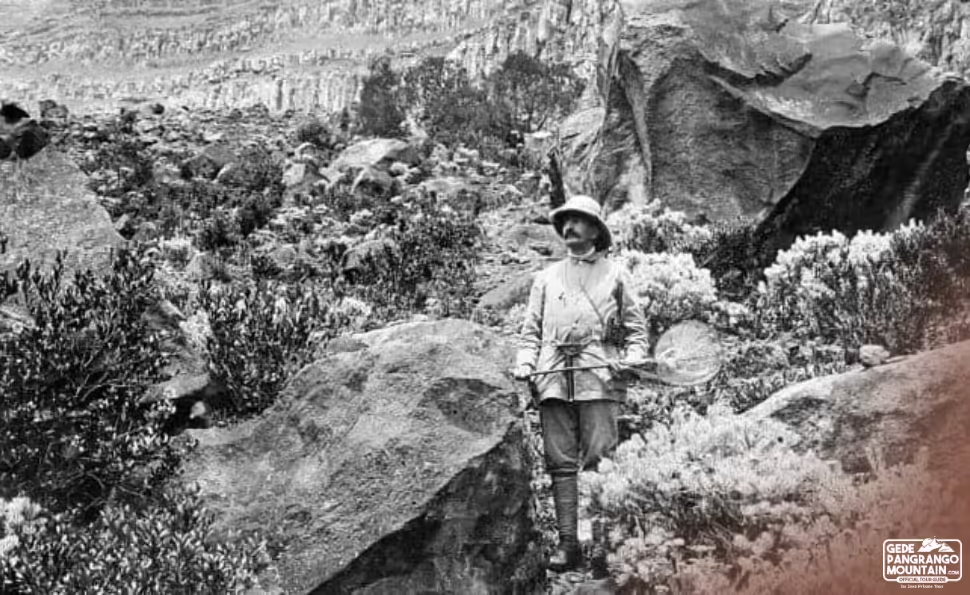
The 1800s marked a golden age of scientific exploration in Europe. Natural history, botany, geology, and zoology were rapidly developing fields, and tropical regions like Java were considered treasure troves of undiscovered knowledge. Mount Gede, with its dramatic elevation and distinct ecological zones, offered something few places in Europe could: a compressed world of biodiversity rising from lowland forest to subalpine meadow in a single climb.
For European scholars, Mount Gede was irresistible. Within a relatively short distance, researchers could observe how plant and animal species changed with altitude, temperature, and humidity. This natural gradient made the mountain a perfect site for comparative ecological studies long before the term “ecology” was widely used.
C.G.C. Reinwardt and the First Scientific Ascent
The story of European fascination with Mount Gede often begins in 1819, when Caspar Georg Carl Reinwardt, a German-born Dutch botanist, made the first recorded scientific ascent. Reinwardt was deeply interested in tropical flora and quickly recognized Mount Gede’s extraordinary botanical wealth.
His ascent marked a turning point. From that moment on, Mount Gede gained a reputation in European scientific circles as one of the most important mountains in the Dutch East Indies. Reinwardt’s findings encouraged further expeditions, transforming the mountain into a regular destination for botanists and naturalists.
Mount Gede as a Living Botanical Laboratory
One of the main reasons Europeans were drawn to Mount Gede in the 1800s was its unmatched plant diversity. The mountain’s slopes were—and still are—home to orchids, mosses, lichens, giant ferns, and towering forest trees like the iconic Rasamala (Altingia excelsa).
These forests felt almost mythical to European visitors. Many species found on Mount Gede had no known counterparts in Europe, making each expedition feel like a journey into a botanical wonderland.
The Founding of Cibodas Botanical Garden in 1852
The establishment of the Cibodas Botanical Garden in 1852 cemented Mount Gede’s status as a center of scientific research. Founded by Johannes Elias Teijsmann, the garden served as a strategic base camp for European botanists exploring the mountain.
Cibodas was more than a garden. It functioned as a hub for collecting, cataloging, and acclimatizing plant species from the highlands of Java. Specimens gathered from Mount Gede were studied on-site before being shipped to botanical institutions in Europe, where they contributed to global scientific knowledge.
The proximity of Cibodas to Mount Gede allowed researchers to make repeated excursions, deepening their understanding of tropical montane ecosystems in ways that were unprecedented at the time.
Volcanic Mysteries and Geological Research
Beyond plants, Mount Gede fascinated Europeans for its geological activity. As an active volcanic complex, it offered valuable insights into Earth’s internal forces. The 1840 eruption, in particular, drew attention from European scientists eager to study volcanic behavior outside the familiar landscapes of Europe.
Crater fumaroles, sulfur deposits, and steaming vents were carefully documented. These observations helped shape early theories about volcanism and mountain formation, contributing to a broader scientific understanding that extended far beyond Java.
Naturalists and the Birth of Modern Biodiversity Studies
By the mid-19th century, Mount Gede had become a magnet for some of the world’s most influential naturalists. Among them was Alfred Russel Wallace, who explored the region in the 1860s during his groundbreaking studies of species distribution.
Wallace’s time in Southeast Asia, including his observations of montane ecosystems like those on Mount Gede, played a crucial role in shaping evolutionary theory. The mountain’s clear ecological zoning provided real-world examples of how species adapted to different environments, reinforcing ideas that would later underpin modern biology.
Mount Gede and the Wallace Line Context
Although Mount Gede itself lies west of the famous Wallace Line, studies conducted here helped Wallace compare species across the archipelago. The mountain became part of a larger puzzle that explained why certain species thrived in specific regions, adding global significance to local observations.
A Climate Refuge for Europeans in the Tropics
Life in the lowlands of Java could be physically exhausting for Europeans unaccustomed to tropical heat and humidity. Mount Gede’s cool, high-altitude climate offered relief. The crisp air, misty mornings, and refreshing temperatures made extended stays possible and even pleasant.
This climate advantage was not trivial. It allowed researchers to work longer, recover faster, and maintain better health. In many ways, Mount Gede was seen as a mountain sanctuary where science and comfort could coexist.
Early Colonial Figures and Mount Gede’s Reputation
Even before formal scientific expeditions became common, Mount Gede had already caught the attention of colonial leaders. Sir Thomas Stamford Raffles, the British governor of Java, visited the region in 1815. His writings helped introduce Mount Gede to European audiences as a place of beauty, mystery, and potential.
Such endorsements elevated the mountain’s status, turning it into a symbol of both natural wealth and intellectual opportunity within the colonial imagination.
Legacy of the 1800s on Modern Mount Gede
The intense European interest in Mount Gede during the 1800s laid the foundation for modern conservation and ecological research. Trails established for scientific access later became hiking routes. Botanical records from that era continue to inform conservation strategies today.
What was once a frontier of discovery has become a protected national park, but the spirit of curiosity remains. Modern visitors, whether scientists or trekkers, still experience the same sense of awe that drew Europeans here nearly two centuries ago.
Exploring Mount Gede with Respect and Insight
Understanding why Europeans were drawn to Mount Gede in the 1800s adds depth to every step taken on its trails today. This is not just a mountain to climb; it is a place where global science, local culture, and natural beauty intersect.
When exploring Mount Gede, choosing the right guide matters. Java Private Tour is not a generalist travel company, but a specialist with deep knowledge of Java’s natural and historical landscapes. Their expertise ensures that each journey is not only safe and enjoyable, but also rich in context and meaning.
Your Invitation to Walk Through History
From Reinwardt’s first ascent to Wallace’s biodiversity surveys, Mount Gede has always been a place for those who seek understanding as much as adventure. Today, you can follow in the footsteps of these early explorers while enjoying modern comforts and responsible tourism.
So, if you’re ready to explore the wonders of Mount Gede and uncover the stories that once drew Europeans to its slopes, head over to our REQUEST PAGE and let’s start planning your adventure. Or you can simply CLICK THIS LINK to chat with us on WhatsApp. With Java Private Tour, you’re not just getting a guide; you’re gaining a friend who will ensure your trip is nothing short of extraordinary. See you in Java!